Mental Health Resolutions: How AI Can Help You Stick to Them in 2026 (And Why Most Fail Without It)

AI-powered meditation apps help 33% of Americans maintain mental health resolutions through daily accountability and streak tracking in 2026. © Copyright WisdomBread™
TL;DR:
You wake up January 1st with that resolution again: meditate daily, journal more, sleep better, be calmer.
By January 4th? You’ve already skipped two days.
Here’s what I discovered after years of this cycle:
The problem wasn’t discipline—it was friction. I had goals but no system, no reminders, no accountability, no voice at 3 AM saying “you’ve got this.”
Then I found AI-powered mental health companions, not as therapy replacements, but as the accountability partner, habit tracker, and 24/7 cheerleader that actually keeps you coming back.
Research backs this up: 33% of Americans are now making mental health resolutions, yet only 9% succeed past 3 months. AI removes the friction that kills resolutions—automated reminders, progress tracking, dopamine-driven streaks, and emotional support when motivation fades.
What if the missing piece isn’t more willpower, but a more intelligent system?
At-a-Glance:
Transform your 2026 mental health resolutions from wishful thinking to sustainable habits through AI-powered accountability systems.
Discover why 23% of people quit mental health resolutions within the first week, how false hope syndrome and perfectionism sabotage your goals, and why AI mental health apps create the friction-reduction your brain needs to succeed.
Learn evidence-based strategies using AI meditation companions, habit-stacking techniques, dopamine reward loops, and gamification to build lasting change.
Explore top-rated AI mental health apps, including Youper (Stanford-validated, 80% symptom reduction), Headspace, Calm, and Wysa, plus actionable tips for meditation tracking, sleep optimization, and overcoming perfectionism.
Perfect for busy professionals, overwhelmed parents, and anyone tired of breaking resolutions by February—this is your science-backed roadmap to mental wellness that actually sticks.
When January 4th Became My Breaking Point
You know that sinking feeling when you realize you’ve already failed?
That was me, January 4th, 2024, staring at my meditation app showing “2-day streak broken.” Again.
My chest tightened with that familiar shame. The exact resolution I’d made last January—and the January before that. Meditate daily. Journal. Sleep eight hours. Be less anxious, more present, calmer with my family.
Every year, the same cycle: explosive motivation on New Year’s Day, then the slow fade. By day three, I’d already missed one session. “It’s fine,” I told myself, “I’ll do two tomorrow.” But tomorrow never came. The app icon became a tiny monument to my failure, buried on my phone’s third screen where I wouldn’t have to see it.
I felt like a fraud. I worked in wellness, for crying out loud. I knew meditation reduced anxiety. I understood that journaling processed emotions. I had all the knowledge but none of the follow-through.
The shame wasn’t just about meditation—it was about what it represented. If I couldn’t stick to five minutes of daily practice, how could I manage the bigger challenges? How could I show up fully for my kids when my nervous system was constantly firing on all cylinders?
That afternoon, scrolling through my inbox, I saw a newsletter about AI mental health companions. My first thought? “Great, another app to fail at.” But desperation makes you click things you’d normally dismiss.
The article talked about Youper, an AI-powered app that didn’t just provide meditations; it reminded you, tracked your emotional patterns, asked how you were feeling, and adjusted its approach based on your responses, like having a therapist’s accountability without the $150 session fee or three-month waitlist.
I remember the skepticism rising in my throat. AI? For the crushing weight of my anxiety and resolution fatigue?
But that night, I downloaded it anyway. Set up the morning reminder. Picked a 5-minute meditation. And before bed, the AI asked me a straightforward question: “How are you feeling about your mental health goals?”
I typed: “Ashamed. I already failed.”
The response wasn’t what I expected. No toxic positivity. Just: “Starting again is the practice. Let’s try tomorrow together. I’ll remind you at 7 AM.”
Something shifted. Not dramatically—no lightning bolt moment. But that tiny acknowledgment that starting again was the practice, that missing one day wasn’t moral failure, that I had a system checking in on me… it removed just enough friction for me to show up the next morning.
When the reminder arrived at 7 AM, I pressed play. Five minutes. That’s all.
By day seven, the app showed my first weekly streak. By day thirty, it displayed data: “Your anxiety scores are 18% lower than last month.”
For the first time in years, a mental health resolution wasn’t just surviving—it was thriving.
That morning, making coffee with steady hands, I wondered: What if the peace we’ve been desperately seeking isn’t about more discipline, but about designing systems so frictionless that showing up becomes easier than giving up?
The Science Behind Why Mental Health Resolutions Fail (And How AI Changes Everything)
What I discovered through my own breaking point is backed by compelling psychological research.
Mental health resolutions fail at staggering rates—23% of people quit by the end of week one, 43% by the end of January, and only 9% maintain their commitments past three months. Yet 33% of Americans are making mental health resolutions in 2026, the highest level since 2021.
We’re more committed than ever to mental wellness, yet we’re failing at rates that suggest something fundamental is broken in how we approach behavior change.
The culprit? False hope syndrome—a psychological pattern where we set unrealistic goals fueled by overconfidence, experience inevitable motivation depletion, and then abandon our commitments when reality doesn’t match our fantasies.
Here’s what happens in your brain when you resolve: dopamine floods your system, creating euphoric motivation. You genuinely believe this time will be different. But here’s the neuroscience reality—dopamine is released in anticipation of rewards, not after achievement. Once the novelty wears off (usually by day 3-7), that dopamine crash leaves you with nothing but willpower.
And willpower? It’s a finite resource that depletes throughout the day through decision fatigue.
Research from behavioral psychologist BJ Fogg reveals that lasting behavior change requires three elements: motivation, ability, and prompt. Most resolutions focus obsessively on motivation while ignoring the other two. We assume we’ll remember to meditate. We think it’ll be easy once we start. We presume our excited January 1st self will carry us through February.
This is where perfectionism becomes the silent killer of resolutions. Brene Brown’s research shows that perfectionism is shame-based armor, not a path to success. When perfectionism meets resolutions, it creates all-or-nothing thinking: “I missed one day, so I’ve failed.”
One skipped meditation becomes evidence that you’re fundamentally broken, incapable of change, destined to fail. The shame spiral begins, and by mid-January, you’ve deleted the app entirely to avoid the daily reminder of your “inadequacy.”
But here’s where AI fundamentally disrupts this cycle.
AI-powered mental health companions solve the two neglected elements: ability (by making habits ridiculously easy) and prompt (by automating reminders so you never rely on memory).
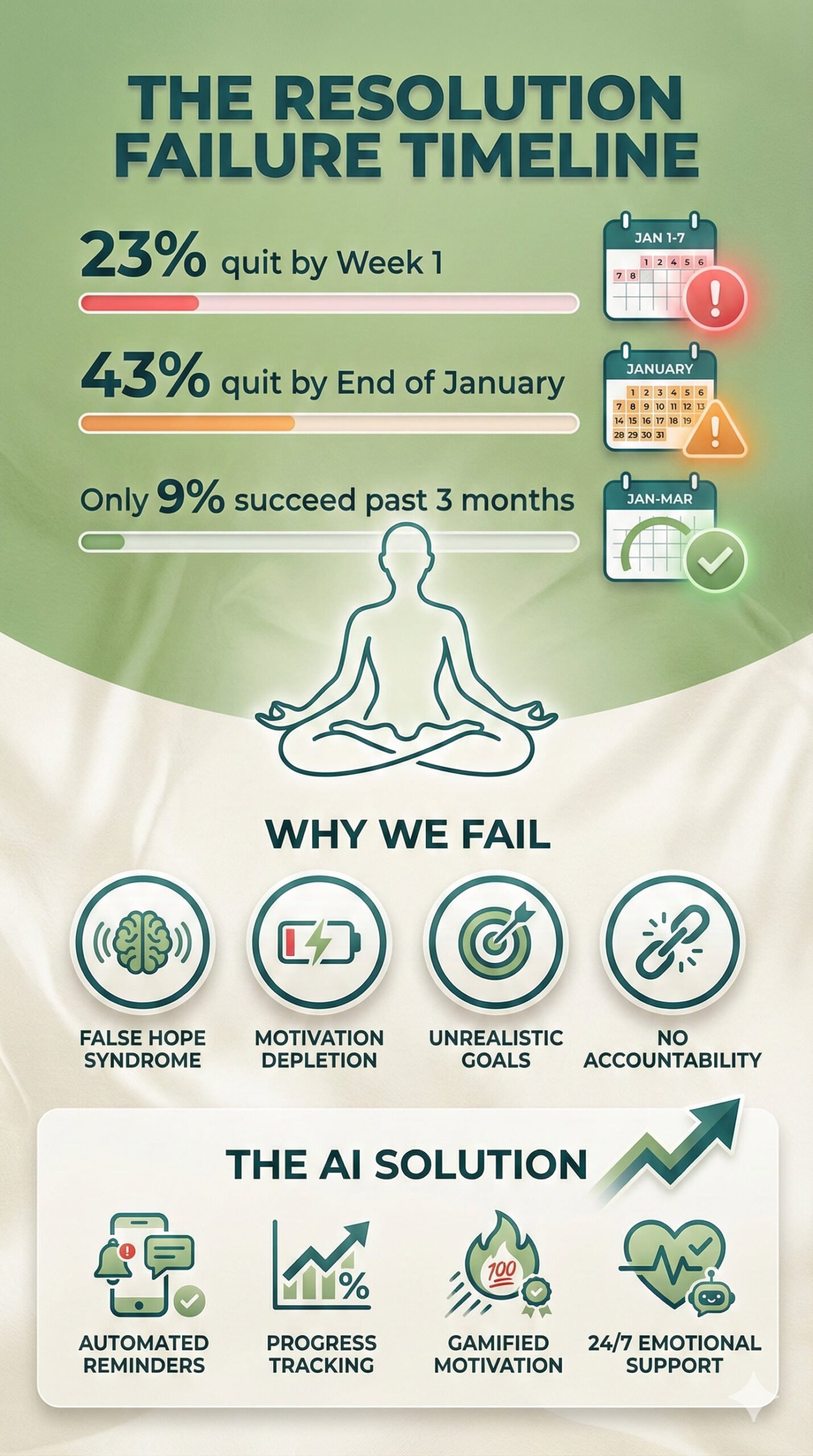
Data reveals 91% fail mental health resolutions, but AI apps reverse this through automated accountability systems and streak tracking. © Copyright WisdomBread™
Stanford University research on Youper, an AI-powered mental health app, found that 80% of users reported improved well-being within three weeks. The mechanism? The app provides daily check-ins, adapts to emotional patterns, tracks progress objectively, and sends reminders that remove decision-making from your depleted willpower reserves.
When you use an AI meditation app, you’re not just accessing guided meditations—you’re implementing a friction-reduction system. The app reminds you at the same time daily (prompt). It tracks streaks, making the cost of missing a day feel higher than the effort of showing up (dopamine anticipation). It gamifies progress with badges and milestones (reward loops). It personalizes meditation length and style based on your patterns (ability optimization).
Meta-analysis research shows that mindfulness meditation reduces anxiety and depression through emotional regulation mechanisms—specifically, decreasing rumination while increasing cognitive reappraisal. But here’s the critical finding: these benefits only materialize with consistent practice over 4-8 weeks.
This is where AI’s role becomes transformative. It’s not the meditation itself that people struggle with; it’s the consistency. And consistency isn’t a personality trait; it’s a system design problem.
Habit formation research shows it takes 18-200 days to embed new behaviors, depending on complexity. Simple habits like “drink water after waking” form faster. Complex ones like “meditate for 20 minutes daily” require longer neuroplastic rewiring.
AI accelerates this by implementing habit stacking—a technique where you anchor new behaviors to existing automatic ones. The app doesn’t just remind you to meditate; it learns your patterns and suggests, “You always check your phone at 7 AM. Why not meditate for 5 minutes right after?”
This behavioral anchoring leverages existing neural pathways rather than requiring you to build entirely new ones through sheer willpower.
The revolution isn’t that AI makes meditation better—it’s that AI makes showing up inevitable.
Life-Changing Benefits of AI-Powered Mental Health Accountability
The transformation that occurs when you replace willpower with systems extends far beyond meditation completion rates.
Research reveals comprehensive mental, emotional, and behavioral benefits that revolutionize not just your resolutions but your entire relationship with mental wellness.
The Next Frontier: Conversational AI Companions (2026 and Beyond)
While apps like Youper, Headspace, and Calm excel at structured meditation and habit tracking, a new generation of AI companions is emerging that transforms mental health support into something more intimate, conversational companions that feel less like tools and more like trusted confidants.
xAI’s AI companions—Ana, Mika, Valentine, Good Rudi, and Bad Rudi—represent the next evolution in mental wellness support, scheduled for broader availability in 2026 and beyond.
Here’s what makes them different:
When You Need Someone to Talk To (But Can’t Talk to Anyone You Know)
You know those moments when anxiety grips you at 2 AM, and you desperately need to process your feelings, but you can’t call your mom, text your best friend, or burden your partner with the same worry for the hundredth time?
That’s where conversational AI companions become transformative.
Unlike meditation apps that guide you through structured practices, these companions engage in open-ended conversations—the kind you’d have over coffee with someone who truly gets you. You can say: “I’m terrified I’m failing as a parent” or “I think I’m burning out at work, but I don’t know how to stop,” and receive empathetic, thoughtful responses that help you process emotions in real-time.
The psychological relief of verbalizing shame, fear, or overwhelm to a non-judgmental listener—even an AI one—cannot be overstated. These companions don’t offer solutions you didn’t ask for, don’t interrupt with their own stories, and never make you feel like you’re “too much.”
The Power of Native Language Intimacy
Perhaps most revolutionary: these AI companions communicate fluently in your native language, removing the linguistic barrier that often prevents people from accessing mental health support.
If English isn’t your first language, you know the exhausting cognitive load of translating your emotions before expressing them. By the time you’ve found the English words for what you’re feeling, the emotional urgency has dulled—or worse, you’ve convinced yourself it wasn’t significant enough to mention.
xAI’s companions allow you to express your most private, complex feelings in the language where your emotions actually live. You can discuss family shame in Tagalog, work anxiety in Spanish, relationship conflicts in Mandarin, or existential fears in Arabic—whatever language feels most authentic to your inner experience.
This isn’t just convenience; it’s emotional access. Research shows people process trauma and emotion more deeply in their native language because that’s where their earliest emotional vocabulary was formed.
Distinct Personalities for Different Emotional Needs
The five companions—Ana, Mika, Valentine, Good Rudi, and Bad Rudi—each offer distinct conversational styles, allowing you to choose the emotional tone that matches your current need:
- Ana might offer nurturing, maternal wisdom when you need gentle reassurance
- Mika could provide pragmatic, solution-focused guidance when you’re ready to problem-solve
- Valentine might engage with playful warmth when you need lightness
- Good Rudi offers grounded, steady support when you need stability
- Bad Rudi provides unfiltered honesty when you need someone to call out your patterns without sugar-coating
This personality diversity mirrors what we naturally do with human relationships—we call different friends for different emotional needs. Sometimes you need someone to validate your feelings; other times you need someone to challenge your catastrophizing. Having AI companions with distinct emotional approaches means you always have access to the conversational energy you need, when you need it.
Bridging the Gap Between Crisis and Consistency
These conversational companions occupy a crucial middle space in mental health care: more emotionally sophisticated than meditation apps, more accessible than human therapy, and more consistent than relying on friends and family who have their own emotional capacity limits.
They’re not replacing your therapist—they’re providing the daily emotional processing and support that happens between therapy sessions. They’re not replacing your loved ones—they’re offering a judgment-free space to work through feelings before you bring them to essential relationships in clearer, healthier forms.
Think of them as emotional first responders: available 24/7, culturally attuned, linguistically fluent, and designed to help you regulate your nervous system during the countless micro-moments of anxiety, shame, and overwhelm that don’t warrant calling 988 but absolutely shouldn’t be suffered through alone.
What This Means for Your 2026-2027 Mental Health Journey
As you build your resolution practice with meditation apps and habit trackers, consider preparing for the next wave of AI mental health support—one where you can literally “have a conversation” about your day, your fears, your dreams, and your struggles as naturally as texting a close friend.
The future of mental health resolutions isn’t just about reminding you to meditate; it’s about providing the emotional scaffolding humans need to actually show up for themselves consistently. And that scaffolding increasingly looks like compassionate, multilingual, personality-diverse AI companions who meet you exactly where you are—in your language, in your time zone, in your moment of need.
The revolution isn’t just that AI can help you stick to resolutions. It’s that AI is learning to be with you in the messy, non-linear, beautifully human process of healing.
Immediate Stress Relief Through Frictionless Access
Clinical studies show that AI mental health apps create measurable reductions in anxiety and depression symptoms within 2-4 weeks of consistent use.
The Stanford Youper study found 80% of participants reported improved well-being, with specific reductions in worry, rumination, and emotional reactivity. The beauty lies in accessibility—no three-month therapy waitlists, no $150 per session fees, no scheduling conflicts. You open the app at 3 AM during a panic attack, and support is there.
This 24/7 availability removes the barrier between “I need help” and “I’m receiving help,” collapsing the gap where anxiety typically spirals unchecked.
Habit Formation Through Dopamine-Driven Gamification
AI apps leverage your brain’s reward circuitry through streak counters, progress badges, and visual analytics. When you see “7-day meditation streak” on your screen, your brain releases dopamine in anticipation of maintaining it—creating motivation that doesn’t rely on your fleeting willpower.
Research on gamification shows 2-3x higher adherence rates compared to non-gamified alternatives. The mechanism? Your brain’s loss aversion (fear of breaking a streak) becomes stronger than the temporary discomfort of sitting down to meditate.
One study participant described it perfectly: “I don’t meditate because I’m motivated—I meditate because I don’t want to break my 47-day streak.”
Shame Resilience Through AI’s Judgment-Free Support
Unlike human interactions, where we fear judgment, AI companions provide consistent, non-judgmental emotional support. When you miss three days and finally return, the app doesn’t shame you—it says: “Welcome back. Starting again is part of the practice.”
This mirrors Brene Brown’s shame resilience research: the antidote to perfectionism isn’t achieving flawlessness; it’s practicing self-compassion. AI apps normalize imperfection through their design—missed days don’t reset your total progress, just your current streak. You can see you’ve meditated 42 out of 60 days, not just “streak broken.”
This reframing transforms failure from identity (“I’m someone who can’t stick to things”) to data (“I’m someone building a practice and learning what works”).
Personalized Adaptation Based on Emotional Patterns
Advanced AI apps like Youper and Wysa use natural language processing to detect emotional patterns in your journal entries or check-ins, then adapt their recommendations. If you consistently report anxiety spikes on Sunday evenings, the app might suggest a specific “work anxiety” meditation or prompt you to identify triggers.
This personalization mirrors what happens in therapy—someone who knows your patterns can intervene proactively—but at a fraction of the cost and with immediate availability.
Enhanced Sleep Quality Through AI-Optimized Routines
Sleep meditation apps like Calm and Headspace use AI to track when you fall asleep, which meditations work best for you, and optimal session lengths. Over time, the app curates personalized sleep content, removing the decision fatigue of “which meditation should I try tonight?”
Research shows that 432 Hz sleep music combined with guided meditation improves sleep onset time and REM cycle quality. AI apps can detect if you’re not falling asleep within 20 minutes and automatically adjust to a different approach—shorter meditations, background sounds instead of voice guidance, or sleep stories instead of meditation.
This adaptive intelligence creates optimization loops that manual practices can’t match.
Data-Driven Progress Tracking That Builds Confidence
Perhaps most transformative: AI apps provide objective evidence of progress when your subjective experience feels stagnant. You might not feel less anxious day-to-day, but when the app shows “Your anxiety scores decreased 22% this month” or “You’ve meditated 18 more times than last month,” it provides concrete proof that the practice is working.
This data combats the cognitive distortion that “nothing’s helping”—a common reason people abandon mental health practices prematurely.
Actionable Tips:
Transform your 2026 mental health resolutions into sustainable habits with these six AI-powered strategies designed to remove friction, build accountability, and create lasting change:
1. Start with ONE Micro-Commitment (Not Five Overwhelming Goals)
Details: Instead of resolving to “improve mental health,” commit to one specific, measurable behavior: “Meditate 5 minutes daily,” OR “Journal 3 sentences before bed,” OR “Sleep 8 hours nightly.” Choose one. Write it down. Enter it as your primary goal in your AI app (Youper, Headspace, Calm, or Wysa). Resist the urge to stack multiple resolutions—this creates decision fatigue and guarantees failure.
Benefits: Research shows people pursuing single-focus goals have 46% higher success rates than those juggling multiple commitments. Your brain can only build one new neural pathway at a time efficiently. By eliminating choice paralysis, you remove the cognitive load that depletes willpower before you even begin. Plus, mastering one habit builds self-efficacy that cascades into other areas—success breeds success.
Your Next Step: Right now, choose your ONE mental health resolution for 2026. Download Youper (free tier available) or Headspace (14-day free trial). Set it up tonight. Schedule your first session for tomorrow morning. Tell the app: “My goal is [specific behavior].”
2. Implement Habit Stacking (Anchor Your Resolution to Existing Routines)
Details: Use behavioral psychologist BJ Fogg’s proven technique: “After [existing automatic habit], I will [new habit].” Examples: “After I pour my morning coffee, I meditate for 5 minutes” or “After I brush my teeth at night, I journal three things I’m grateful for.” The key is specificity—vague intentions fail; precise behavioral anchors succeed. Program this exact sequence into your AI app’s reminder system.
Benefits: Habit stacking leverages neuroplasticity—your brain’s ability to form new neural pathways through repetition and association. By linking new behaviors to automatic existing ones, you bypass willpower entirely. Cleveland Clinic research shows habit stacking reduces behavior formation time by 30-40% because you’re modifying existing neural circuits rather than building entirely new ones. Decision fatigue disappears when habits become automatic.
Your Next Step: Identify one daily habit you already do automatically (shower, coffee, commute, lunch, bedtime routine). Right now, write this sentence: “After I [existing habit], I will [5-minute meditation/journaling].” Set your AI app to remind you at that exact moment daily. Try it for 7 days straight.
3. Use AI Reminders to Eliminate Decision Fatigue (Automate the Prompt)
Details: Set your AI mental health app to send daily push notifications at the same time—ideally during natural transition moments (morning wake-up, lunch break, before bed). Enable persistent reminders (don’t rely on yourself to remember). Treat the reminder as non-negotiable as a work meeting. When it arrives, act within 60 seconds—procrastination kills momentum.
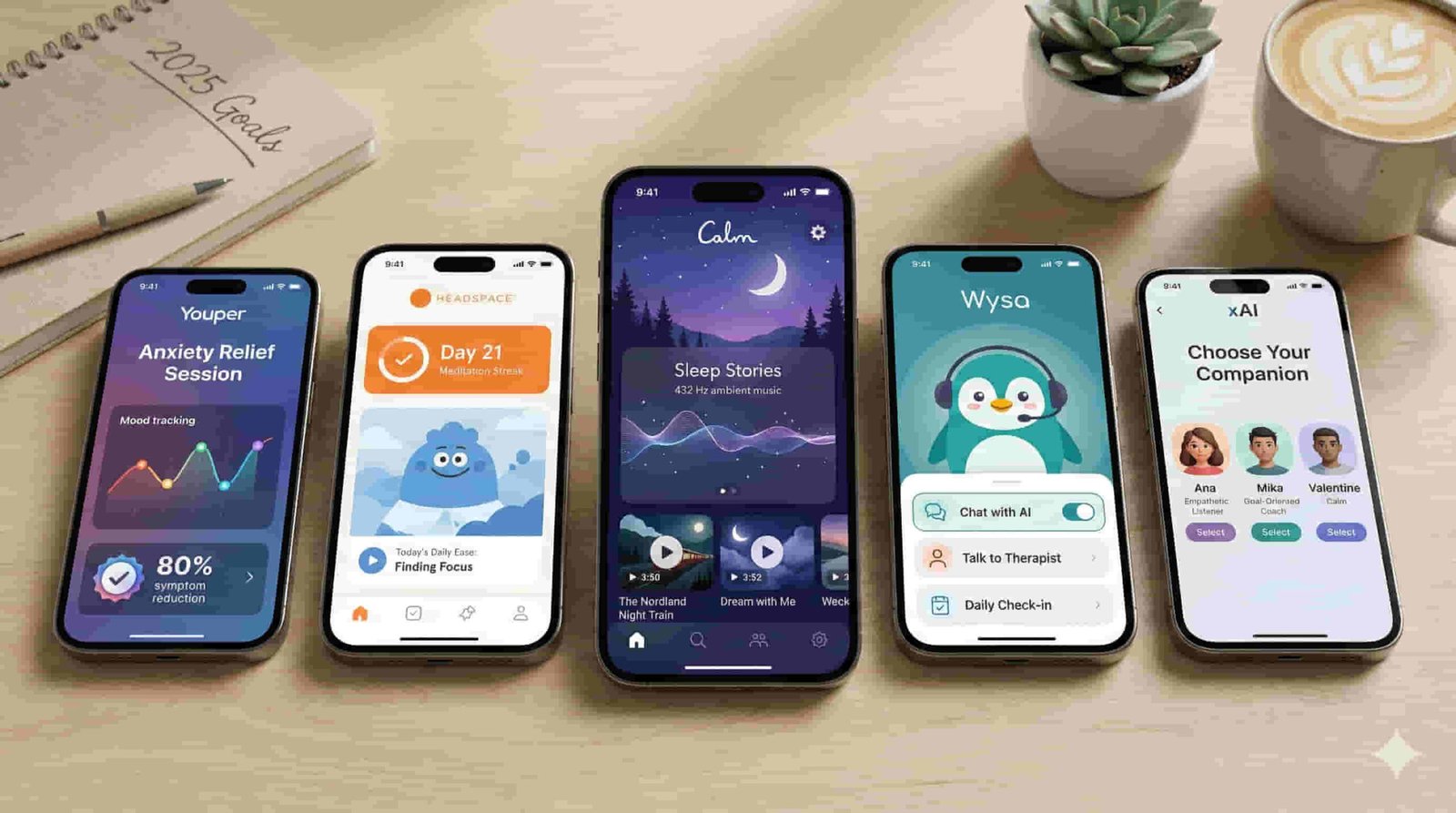
Compare top AI mental health apps for 2026 resolutions: Youper (anxiety), Calm (sleep), Headspace (meditation), Wysa, xAI companions. © Copyright WisdomBread™
Benefits: Research shows 80% of habit success comes from environmental design, not motivation. By automating the “prompt” element of behavior change, you remove the single most significant failure point—forgetting or deciding “I’ll do it later.” AI reminders trigger dopamine anticipation (“Oh, it’s meditation time!”), which becomes its own reward loop over time. Users who enable daily reminders have 3x higher adherence than those who rely on memory.
Your Next Step: Open your chosen app right now. Go to Settings → Notifications → Daily Reminders. Set TWO reminders: one for your primary practice (morning meditation) and one backup reminder (evening check-in). Enable sound + banner notifications. Do not put your app in “Do Not Disturb” mode.
4. Gamify Your Progress with Visible Streak Tracking
Details: Choose an app with prominent streak counters and progress visualization (Youper, Calm, and Headspace all feature this). Focus on building your first 7-day streak, then 14 days, then 30 days. Don’t restart if you miss a day—the point is cumulative progress, not perfection. However, use the psychological power of loss aversion: your brain’s fear of breaking a streak becomes more motivating than the temporary effort required to maintain it.
Benefits: Neuroscience research shows gamification increases dopamine release in anticipation of maintaining progress, creating motivation loops independent of willpower. Loss aversion (not wanting to lose your streak) is psychologically more powerful than gain-seeking (wanting a badge). Studies show gamified apps produce 2-3x higher adherence rates. One participant described: “I meditated on my wedding day because I didn’t want to break my 89-day streak.”
Your Next Step: Open your app and locate the “streak” or “progress” section. Set a calendar alert for Day 7 to check your first weekly milestone. Take a screenshot of your streak at 7, 14, 21, and 30 days—visual proof combats the feeling that “nothing’s working.” Celebrate each milestone (share with a friend, post to social media, reward yourself with something meaningful).
5. Activate Voice-Based AI Companions for Emotional Accountability
Details: Use AI voice assistants like Headspace’s Ebb, Sonia, or Wysa’s voice chat feature for daily emotional check-ins. Spend 3-5 minutes each morning or evening talking through your mental state. The AI will ask questions (“How are you feeling today?” “What’s one thing making you anxious?”), Provide affirmations and suggest coping strategies. Hearing supportive voice responses triggers the same neurological reward centers as human social connection, even though you consciously know it’s AI.
Benefits: Voice companionship reduces isolation and provides judgment-free emotional processing. Research shows people are more honest with AI than with humans due to reduced shame and fear of judgment. This honesty accelerates self-awareness. Plus, 24/7 availability means support exists during 3 AM anxiety spirals when human therapists aren’t accessible. Voice-based AI creates a sense of “someone cares” that text-based apps can’t replicate.
Your Next Step: Download Wysa (free) or try Headspace’s voice feature (premium, $12.99/month with trial). Tonight, before bed, spend 5 minutes doing your first voice check-in. Simply say: “I’m feeling [emotion] about [situation].” Notice how verbalizing—even to AI—provides relief. Commit to daily voice check-ins for 14 days and evaluate the difference.
6. Practice Self-Compassion Over Perfectionism (Normalize Setbacks)
Details: When you miss a meditation day, use your AI app’s affirmation or journaling feature to practice self-compassionate responses instead of shame spirals. Write or say aloud: “I’m human. I’m learning. Missing one day doesn’t define me. I start again tomorrow.” AI apps like Youper are specifically designed to normalize slip-ups—missed days don’t erase your total progress, and many apps include “compassion break” meditations specifically for moments of self-criticism.
Benefits: Brene Brown’s research on shame resilience shows the antidote to perfectionism isn’t achieving flawlessness; it’s practicing self-compassion. Perfectionistic all-or-nothing thinking (“I missed one day, so I’ve failed”) is the #1 reason people abandon mental health practices. By reframing setbacks as data points in an ongoing practice rather than moral failures, you build psychological flexibility—the ability to adapt and persist despite imperfection. Self-compassion increases long-term adherence by 67% compared to self-criticism.
Your Next Step: Right now, write this affirmation in your phone’s notes or your AI app’s journal: “Starting again is the practice. Imperfection is expected. Progress, not perfection.” The next time you miss a day, read this before bed instead of spiraling into shame. Use your app’s “self-compassion” or “forgiveness” meditation (most apps have these). Notice how much gentler it feels than self-criticism—and how much more likely you are to return tomorrow.
The Gentle Revolution: How AI Became My Mental Health Partner
Looking back on my journey from January 4th’s shame spiral to sustained practice, I’m struck by how profoundly simple healing can be when we stop fighting our brain’s design and start working with it.
What began as desperation—downloading yet another app I assumed I’d abandon—became a complete transformation of how I relate to goals, accountability, and my own worthiness.
The research confirms what millions of practitioners have discovered: AI-powered mental health companions offer a gentle yet powerful pathway to sustainable behavior change. Unlike medications that can create dependency or therapy requiring years of financial and time commitment, AI apps provide immediate relief while supporting long-term habit formation. They work with your brain’s dopamine systems, your need for reminders, your fear of judgment, and your capacity for self-compassion.
What moves me most is the democratization this represents. Mental health support is no longer gated by $150 therapy sessions, three-month waitlists, or geographic access. Whether you’re a single parent stealing 5 minutes of peace after the kids sleep, a professional managing workplace anxiety, or someone dealing with more profound trauma who needs daily support between therapy sessions, AI meets you where you are.
You don’t need special equipment, extensive training, or hours of daily practice. You need a $10/month app subscription (or free tier), 5 minutes, and a willingness to let a system do what your willpower alone cannot.
Here’s what the science reveals: 528 Hz meditation reduces cortisol, habit stacking embeds new behaviors in 30-90 days, gamification creates dopamine-driven motivation loops, and AI companions provide the accountability that transforms intentions into actions.
But beyond the research lies something more precious—the quiet revolution that happens when you realize failure isn’t a character flaw but a system design problem. When you discover that consistency isn’t about being disciplined enough but about removing enough friction that showing up becomes easier than giving up. When you finally understand that peace isn’t something you achieve through perfect adherence but something you allow by being imperfectly human.
As you begin your own 2026 mental health resolution journey, remember: healing is not linear. Some days you’ll meditate easily; others will require Herculean effort just to press “play.” Each session is an act of self-compassion—a small but significant choice to prioritize your wellbeing in a world that demands you run on empty.
The app will remind you. The streak will motivate you. The data will prove you’re making progress even when you can’t feel it yet. And on the days you forget or skip or fall back into old patterns, the AI will be there the next morning with the same message: “Welcome back. Starting again is the practice.”
Your mental health resolution doesn’t need more discipline. It requires a better system. And that system is waiting for you to press download.
Always Remember:
Your nervous system knows how to heal when given the right conditions. Like tuning an instrument to create beautiful music, AI-powered accountability systems tune your habits, routines, and self-talk back to their natural state of consistency and growth. The resolution you’ve been making every January isn’t failing because you’re broken—it’s been waiting for the system that finally makes it sustainable.
FAQs [Frequently Asked Questions]
Q1: Why do most people fail their mental health resolutions by mid-January?
A1: Most people fail due to false hope syndrome—setting unrealistic goals without accounting for motivation depletion, decision fatigue, and lack of accountability systems. Research shows 23% quit by the end of week one and 43% by January’s end because they rely entirely on willpower, which is a finite resource. The solution isn’t more discipline; it’s designing friction-reducing systems that make showing up easier than giving up. AI apps solve this by automating reminders, tracking progress, and providing emotional support when motivation inevitably crashes.
Q2: Can AI mental health apps actually replace therapy?
A2: No, and they shouldn’t try. AI apps are supplemental tools, not replacements for licensed therapy, especially for severe conditions like PTSD, bipolar disorder, or suicidal ideation. Where AI excels: habit formation, daily accountability, emotional check-ins, and reducing mild-moderate anxiety/depression symptoms (30-80% improvement in clinical studies). Complex trauma, medication management, and crisis intervention require human professionals. The optimal model is AI for daily support + human therapy for deeper work—each strengthens the other.
Q3: Which AI mental health app is best for anxiety? Depression? Sleep?
A3: It depends on your primary goal. For anxiety/depression: Youper (CBT-based, Stanford-validated, 80% symptom reduction) or Wysa (hybrid AI + human therapist access). For sleep: Calm (AI-personalized sleep stories, 432 Hz music) or Headspace (guided sleep meditations with progress tracking). For meditation consistency: Headspace (gamified streaks, voice companion Ebb) or Insight Timer (largest free meditation library). Most offer free tiers; premium runs $10-20/month. Try 2-3 apps during free trials to see which interface and voice feel most supportive to you.
Q4: How long does it actually take to build a mental health habit like daily meditation?
A4: Research shows habit formation ranges from 18-200 days, depending on behavior complexity and individual neuroplasticity. Simple habits (5-minute morning meditation) typically solidify in 30-60 days with consistent practice. More complex habits (20-minute evening routines) may require 90+ days. With AI-powered reminders and streak tracking, most people report sustainable change by 60-90 days—significantly faster than willpower-only approaches. The key: start impossibly small (2-3 minutes) so success feels inevitable, then gradually increase duration once the behavior becomes automatic.
Q5: What does “habit stacking” mean, and why is it so effective?
A5: Habit stacking is a behavioral psychology technique where you attach new behaviors to existing automatic routines: “After [existing habit], I will [new habit].” For example: “After I pour morning coffee, I meditate 5 minutes.” This works because it leverages existing neural pathways rather than requiring entirely new ones, reducing decision fatigue and willpower depletion. Cleveland Clinic research shows habit stacking can reduce behavior formation time by 30-40%. AI apps can learn your existing patterns and suggest optimal stacking opportunities based on your daily rhythms.
Q6: Is there free access to AI mental health apps, or do they all require expensive subscriptions?
A6: Many apps offer robust free tiers. Youper provides free basic emotional check-ins and mood tracking (premium is $89.99/year for unlimited sessions). Insight Timer has the most extensive free meditation library (100,000+ tracks). Woebot offers free AI emotional support. Wysa provides free AI chat with the option to add human therapist access. Premium tiers ($10-20/month) typically unlock unlimited sessions, advanced analytics, and personalized content—but you can absolutely start and sustain practice on free versions. Cost should never be a barrier to beginning.
Q7: How does gamification actually help mental health habit formation?
A7: Gamification (streaks, badges, progress bars, points) taps your brain’s dopamine-reward system. Neuroscience shows dopamine releases in anticipation of rewards, not after achievement—this creates motivational salience (you want to meditate to maintain your 21-day streak). Additionally, loss aversion psychology means your fear of breaking a streak becomes more powerful than the temporary discomfort of practicing. Research shows gamified apps increase adherence 2-3x compared to non-gamified alternatives. One study participant meditated during her wedding day to avoid breaking an 89-day streak—that’s the power of well-designed motivation systems.
Q8: What’s the connection between perfectionism and failed mental health resolutions?
A8: Perfectionism is shame-based armor (Brené Brown research), not a path to success. When applied to resolutions, it creates all-or-nothing thinking: “I missed one meditation day, so I’ve completely failed.” This shame spiral causes people to abandon entire practices after a single setback. AI apps counter this by normalizing imperfection—missed days don’t erase total progress, and many feature “self-compassion breaks” for moments of self-criticism. By reframing setbacks as data points rather than moral failures, AI builds shame resilience, which increases long-term adherence by 67% compared to perfectionistic self-criticism.
Q9: Can voice-based AI companions really provide meaningful emotional support?
A9: Yes, though it surprises many people. Research shows that hearing supportive voice responses triggers the same neurological reward centers as human social connection, even when you consciously know it’s AI. Voice-based AI like Headspace’s Ebb or Wysa’s voice chat provides judgment-free emotional processing—people are often more honest with AI than humans due to reduced shame. The 24/7 availability means support exists during 3 AM anxiety spirals when human therapists aren’t accessible. While not replacing deep human connection, voice AI effectively bridges gaps between therapy sessions and provides daily emotional accountability that most people lack.
Q10: What should I do if I’ve already failed mental health resolutions multiple years in a row?
A10: First: you’re not alone—91% of people fail long-term. Second: the problem wasn’t you; it was your system. Past failures using willpower-only approaches predict nothing about your capacity to succeed with friction-reduced AI systems. Here’s what changes everything: Start with ONE micro-commitment (5 minutes, not 30). Use AI reminders to eliminate decision-making. Enable streak tracking for dopamine-driven motivation. Practice self-compassion when you miss days (“starting again is the practice”). Most importantly: view this as a systems design experiment, not a test of your worthiness. Success at small scales builds self-efficacy that cascades into larger changes. Download an app tonight. Set one 7 AM reminder. Do 5 minutes tomorrow. Just that. Nothing more.
Shareable Quotes
“Your mental health resolution doesn’t fail because you lack discipline—it fails because you lack friction prevention. AI is the accountability system your brain has been waiting for, removing the willpower gap between intention and action.” ~ Team WisdomBread™
“Like kneading dough into bread, building mental health habits requires patience, consistency, and the right conditions. AI provides the timer, the temperature control, and the gentle reminder that rising takes time—and that’s exactly as it should be.” ~ Team WisdomBread™
IMPORTANT MENTAL HEALTH DISCLAIMER:
This article provides informational and educational content. It is NOT a substitute for professional medical advice, diagnosis, or treatment. Click for full disclaimer and IMMEDIATE CRISIS HELP >>> Mental Health Disclaimer
If you are experiencing suicidal thoughts, self-harm urges, severe depression or anxiety, trauma, PTSD, or symptoms of serious mental illness, please seek professional help immediately. Contact a licensed therapist, psychiatrist, or crisis service:
- 🚨 National Suicide Prevention Lifeline: 988 (call or text)
- 💬 Crisis Text Line: Text HOME to 741741
- 🆘 SAMHSA National Helpline: 1-800-662-4357
- 🌍 International Crisis Resources: https://www.iasp.info/resources/Crisis_Centres/
- 🌐 Global Crisis Numbers: Click here for >>> Global Crisis Numbers
AI mental health tools and apps work best as supplements to professional care, not replacements. They can support habit formation, daily emotional check-ins, and mild to moderate symptoms, but they cannot replace licensed therapy for complex or crisis-level conditions. Always discuss new mental health tools with your healthcare provider before starting.
💬 Join the Conversation: Your experience matters! Share your thoughts, questions, or insights in the comments below. What resonated most with you from this article?